

What Accessories Do I Need to Complete My Electronic Drum Kit Setup?
Share
You have got your electronic drum kit. You are excited. You want to play.
And then you realise — you cannot hear a thing.
Or the kit is slowly creeping across the floor every time you hit the kick pedal. Or your back is aching after ten minutes because you are sitting on a dining chair. Or your sticks snapped on the third day and you have no idea what to replace them with.
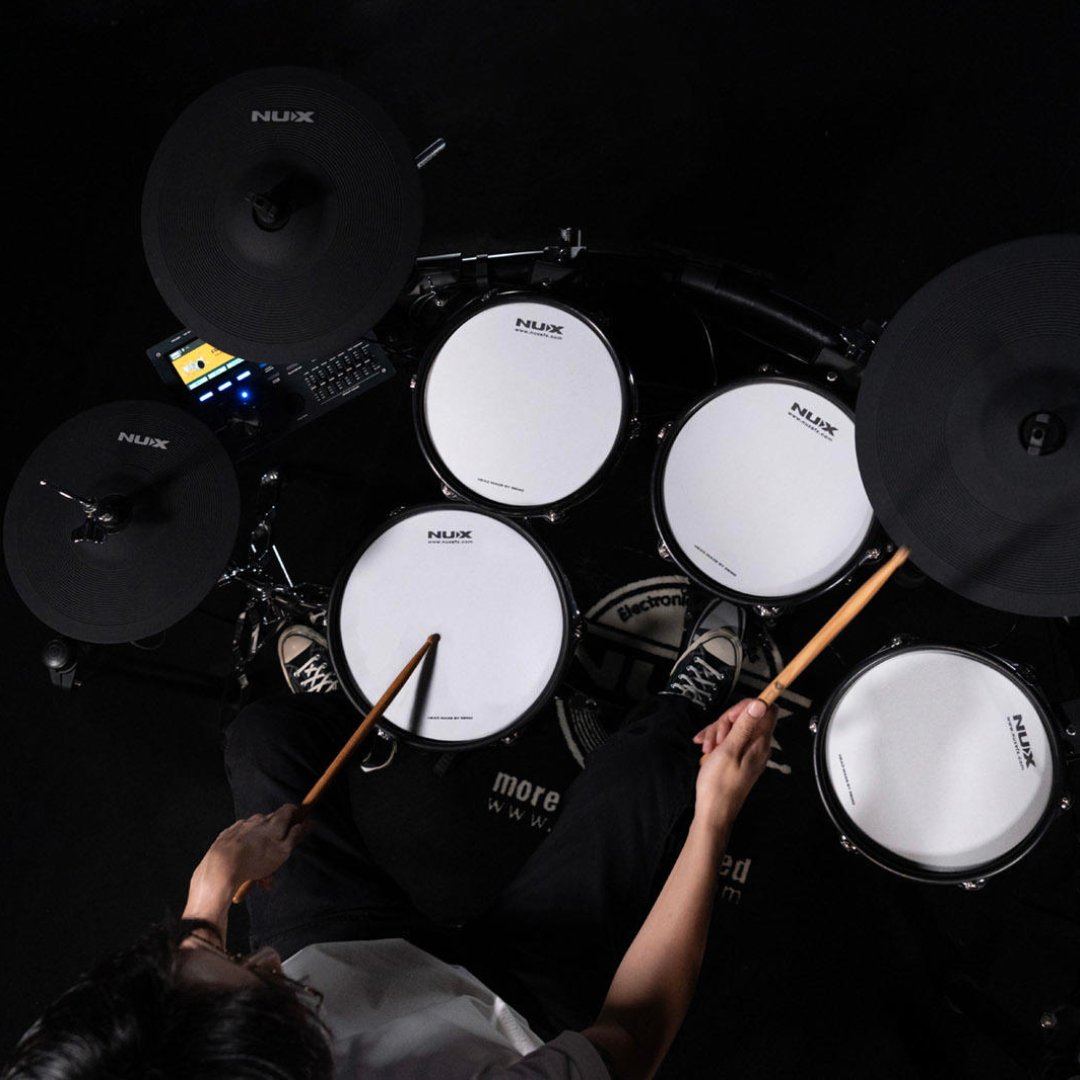
These are the moments that catch new drummers off guard. The kit is the main event, but without the right accessories around it, the experience is incomplete — sometimes frustrating, sometimes genuinely unplayable. This guide covers every essential accessory, why it matters, and what to look for when choosing one.
Step One: You Need to Actually Hear Your Kit
This is the one that surprises people the most. Electronic drum kits make no musical sound on their own. The pads are silent triggers — they send a signal to the module, which generates the drum sounds digitally. Without something to output that audio, all you hear is the quiet mechanical tap of the pads.
To hear your kit, you need one of two things: headphones or a drum speaker. They are not interchangeable — they serve different purposes — and choosing the right one matters more than most people expect.
Drum Headphones: Just You and the Music
Headphones plug directly into the module's headphone jack. Only you hear the sound. This is the setup most home drummers use, and for good reason: it is perfect for UAE apartments and villas where you want to practise without disturbing anyone around you.
But not just any headphones will do. Here is why this matters:
- Wireless headphones introduce latency. Even "low latency" Bluetooth modes add a small but noticeable audio delay between hitting a pad and hearing the sound. For music listening, you would never notice. For drumming, where every millisecond of timing matters, it immediately throws you off. This is one of the most common complaints we hear from new drummers — "my kit sounds delayed" — and nine times out of ten, it is the Bluetooth headphones.
- Consumer headphones are voiced for music, not drums. Many popular headphones boost bass and treble to make music sound exciting. On drums, this makes the sounds feel unnatural and fatiguing over time.
- Drum headphones are wired, closed-back, and flat-response. Wired means zero latency. Closed-back means they seal around your ears and block out the tap of the pads. Flat-response means you hear the drum sounds accurately, the way they were designed to sound.
Browse our range of drum headphones — every option is wired and selected specifically for electronic drum use.
Drum Speaker (Amplifier): So Everyone Can Hear You Play
A drum speaker connects to the module's audio output and plays the sound out loud. This is the setup to choose if you are playing with other musicians, performing, practising in a larger space, or simply prefer not to wear headphones during long sessions.
Again, the type of speaker matters enormously:
- Bluetooth speakers: do not use them. Same latency problem as wireless headphones. You will hear a delay on every single hit. This is not a fault with your kit — it is the wireless connection. Always use a wired connection with electronic drums.
- Guitar amps: not suitable. Guitar amplifiers are voiced for guitar frequencies — a mid-heavy range that makes drum sounds thin, harsh, and unbalanced. Pushing a guitar amp with drum signals can also damage it over time.
- Drum amplifiers (also called drum monitors or percussion amps) are purpose-built. They handle the full frequency range of a drum kit — from the deep thud of a kick to the sharp crack of a snare and the shimmer of a cymbal — cleanly and accurately. They connect via a standard wired audio cable, which means zero latency every time.
If you have ever plugged your kit into a home speaker and thought the kick sounded weak or the cymbals sounded harsh — that is the speaker, not the kit. A proper drum amp is a revelation.
See our drum speakers, including the Hampback SK-50 50W Drum Amplifier, which connects via wired audio for zero-latency performance.
The Drum Throne: Your Foundation
A drum throne is a purpose-built stool designed specifically for drummers. It is not just about comfort — though comfort matters on long practice sessions — it is about posture, technique, and control.
Playing on a regular chair or a bar stool creates problems you might not notice immediately but will definitely feel over time: the wrong height puts your legs at the wrong angle for the pedals, the wrong seat shape restricts your hip movement, and an unstable seat makes it impossible to develop consistent technique. A proper drum throne is height-adjustable, stable, and designed to support the physical demands of playing.
Two things to consider when choosing a throne:
- Height adjustment — spiral thread vs hydraulic. Spiral (threaded) thrones are adjusted by twisting the seat up or down along a post. They are reliable and found on most entry-level and mid-range thrones. Hydraulic thrones work like an office chair — press a lever and adjust instantly. Preferred if multiple people share the kit, or if you want the quickest setup each time.
- Seat shape — round vs motorcycle (saddle). Round seats are the classic shape, symmetrical and easy to sit on from any angle. Motorcycle or saddle seats are narrower in the middle, encouraging a more open hip position that reduces fatigue and frees up leg movement for pedal work. Many drummers prefer the saddle shape once they have tried it.
We stock the PDH DWT-49 Hydraulic Drum Throne and the full range of drum thrones — hydraulic and spiral thread, round and saddle seat.
Drum Sticks: More Important Than You Think
Every electronic drum kit comes with a pair of sticks in the box. Those sticks are fine for getting started — but they are usually basic, and you will go through them faster than you expect. Having a spare pair (or two) on hand from day one is a habit every drummer develops quickly.
Drum sticks vary in thickness, length, tip shape, and material, and each combination produces a different feel and sound. For most beginners on an electronic kit, a standard 5A stick is the go-to recommendation: medium weight, comfortable in most hand sizes, versatile across styles, and the most widely used size in the world for good reason.
A few things worth knowing:
- Nylon tip vs wood tip. Nylon tips produce a brighter, more consistent sound on cymbals and are slightly more durable. Wood tips give a warmer, more natural sound. On electronic drums, the difference is subtle — either works well.
- Do not use brushes or hot rods on standard electronic pads unless the manufacturer specifically says they are compatible. Some pad surfaces are not designed for brushes and can be damaged.
- Buy more than one pair. Sticks break. Keep spares.
Pick up the TDC 5A Drumsticks — a reliable, well-balanced 5A stick that works well on electronic drum pads.
The Drum Rug: The Accessory That Saves Your Sanity
If you are setting up on a hard floor — tiles, wood, marble, laminate — a drum rug is not optional. It is essential.
Here is what happens without one: every time you press the kick pedal, the force pushes the kit slightly forward. Slowly at first, then faster. Within minutes you are shuffling forward on your throne to keep up, losing your playing position, and eventually stopping to push everything back. We have had customers tell us they used everything from furniture leg pads to — memorably — a cement block in front of the pedal to try to solve this. A drum rug is the actual solution.
Why a regular household rug does not work:
- Most home rugs are too soft — the rack feet sink in unevenly, making the kit wobble.
- They are not sized or shaped for a drum kit, so pedals end up half on, half off.
- They do not grip hard floors under repeated pedal impact the way a drum rug does.
A proper drum rug is low-pile and firm, has a non-slip rubber backing designed for repeated pedal impact, and is sized to fit the full footprint of a drum kit — rack feet, hi-hat stand, and both pedals all on the rug at once.
We stock the the PDH Drum Rug Carpet — purpose-built for electronic and acoustic drum setups on hard floors.
The Complete Setup Checklist
To summarise, here is everything you need for a complete electronic drum kit setup:
- ✅ Electronic drum kit — the kit itself (rack, pads, module)
- ✅ Drum Headphones — essential for you to hear the sound; wired only
- ✅ Drum speaker — essential for others around you to hear the sound; wired only
- ✅ Drum throne — height-adjustable, purpose-built for drummers
- ✅ Drum sticks — 5A is the standard starting point; always keep spares
- ✅ Drum rug — non-negotiable on hard floors
If you bought one of our Starter Packs, your throne, headphones, and sticks are already included. If you bought a Bundle, you also have a drum rug and drum speaker. Both formats are exclusive to The Drum Shop — curated by drummers, so you get everything you actually need in one order.
Not Sure What You Need? Ask Us.
Every setup is a little different — the size of your space, whether you are playing alone or with others, whether you are in an apartment or a villa, whether your floor is marble or carpet. If you are not sure which accessories are right for your situation, reach out to our team. We are drummers, we know these products firsthand, and we are happy to point you in the right direction.
Browse all drum accessories at thedrumshop.ae — with free delivery across the UAE on drum kits.